A Guide to Qualitative Research Analysis Methods
Discover key qualitative research analysis methods and learn how to transform raw data into powerful insights. This guide makes complex concepts simple.

So, you've gathered a mountain of interview transcripts, observation notes, and open-ended survey responses. What now? This is where qualitative research analysis comes in. It’s the art and science of making sense of non-numerical data—words, stories, and experiences—to uncover the why behind the what.
While quantitative methods are great for telling you how many or how much, qualitative analysis dives deep into the human side of the story. It’s all about finding the patterns, themes, and narratives hidden within your data to understand the rich context and meaning of people's actions.
What Is Qualitative Analysis Really About?

Think of it like this: A sales report tells you a local coffee shop sells 500 lattes a day. That's a solid number, but it doesn't explain why people line up out the door. Is it the beans? The prices? The free Wi-Fi?
Qualitative analysis is what happens when you sit in that coffee shop for an afternoon. You listen to the chatter, watch the regulars interact with the staff, and soak up the atmosphere. You start to realize it's about the friendly barista who remembers everyone's name, the cozy armchairs, and the genuine sense of community. That’s the story the numbers can't tell you.
This process turns a pile of messy, unstructured data into a clear, compelling story. It's a systematic journey of organizing and interpreting information to find the gold. If you're new to this, a good step-by-step guide on how to analyze qualitative data can be an invaluable starting point.
Ultimately, the path from raw interview notes to powerful insights demands that you get your hands dirty. You have to immerse yourself in the material, constantly questioning what you're reading and looking for those subtle connections that aren't obvious at first glance.
Uncovering the Stories Behind the Data
At its core, qualitative analysis is about giving a voice to the human stories that statistics simply can't capture. It allows you to step into your participants' shoes and understand their world from their perspective. This is how you answer the really important questions:
- Why do customers really choose one product over another? You get to unpack the emotional drivers and personal values behind their decisions.
- How do employees feel about a new company policy? You can capture the nuances of their support, resistance, or confusion.
- What is it actually like to live in a particular community? It helps you explore the unspoken social rules and cultural dynamics at play.
Qualitative research isn't satisfied with surface-level descriptions. It seeks to understand the complex tapestry of human experience, explaining why things are happening from the viewpoint of the people involved.
The Evolution of Qualitative Inquiry
Qualitative research isn't a new invention; it has deep roots in the work of early anthropologists like Bronislaw Malinowski and Margaret Mead. In the beginning, the goal was often to find a single, "objective" truth.
But the field has grown up quite a bit since then. Today, it embraces a wide range of philosophies and approaches, making it an essential tool for everything from community research to cross-cultural studies.
This evolution reveals a key point: qualitative analysis is more than just a set of techniques—it’s a mindset. It’s about committing to see the world through someone else’s eyes and translating their experiences into a structured, meaningful narrative that can drive real change and deepen our understanding of what it means to be human.
Setting the Stage for Meaningful Analysis
Upload a file. Get text back. That simple. Try it free

Before you can pull meaningful stories from your research, you have to get your data in order. Think of it like a chef prepping ingredients before cooking a big meal—this initial setup isn't just busywork. It’s the foundation for every insight you’ll uncover later.
Nailing this stage protects the integrity of your findings and makes the whole analysis process run smoother. It’s all about turning a pile of raw recordings and scattered notes into a clean, organized dataset that’s ready for a deep dive.
The First Step: Accurate Transcription
Your analysis is only as strong as the data it’s built on. For interviews, focus groups, or any recorded conversations, that means one thing is non-negotiable: accurate transcription. Every "um," pause, or shift in tone can be a clue, and a sloppy transcript can send you down the wrong path entirely.
Spending hours manually transcribing audio is not only painfully slow, but it also drains the energy you should be using for analysis. A reliable tool here is a lifesaver, capturing the richness of the conversation without eating up all your time.
For researchers who can’t sacrifice speed or precision, Typist is a perfect fit. It turns your audio and video files into highly accurate text in just a few seconds, keeping all the nuances of speech intact. This lets you jump straight from raw recordings to a searchable document that becomes the bedrock of your analysis.
Turn podcast episodes into blog posts
Upload your recording, get a transcript, export to any format. Repurpose content in minutes
Organizing and Preparing Your Data
Once you have accurate transcripts, the next job is to bring some order to the chaos. A logical system for organizing your data will save you from major headaches down the line.
Think of this as building a library for your research. Every book (or file) needs a clear label and its own spot on the shelf. That way, you can grab exactly what you need, right when you need it.
Here are a few essential prep tasks to get you started:
- Create a Consistent Naming System: Come up with a clear, simple convention for naming your files (e.g.,
ProjectName_Interview_Participant01_Date.docx). This tiny bit of discipline makes finding specific interviews a breeze as your project gets bigger. - Anonymize Participant Data: Protecting confidentiality is a core ethical duty in qualitative research. Before you begin your analysis, be sure to remove or replace all personally identifiable information—names, companies, specific locations—with codes like P1 or P2.
- Perform an Initial Read-Through: With everything organized and anonymized, read through all your transcripts once. Don't try to analyze anything just yet. The goal is to simply immerse yourself in the data, get a feel for the overall tone, and make a note of any quotes or ideas that jump out at you.
This prep work isn't just about housekeeping; it's your first real step into the analysis. By familiarizing yourself with the landscape of your data now, you’ll be much better equipped to apply the formal analysis methods we’ll cover next.
Try Typist free - Get 3 transcripts daily
Your Toolkit of Core Analysis Methods
https://www.youtube.com/embed/j9A3ceOBihM
Once your data is clean and organized, the real fun begins—finding the story hidden inside. But there’s no single "right" way to do this. Different research questions call for different analytical tools. Choosing the right one is like a skilled craftsperson selecting the perfect tool for the job.
This section breaks down five of the most powerful and widely used qualitative research analysis methods. I'll use simple analogies to make each one click, so you can see its unique purpose and decide which approach is the best fit for your project.
1. Thematic Analysis: Sorting Your Ideas into Meaningful Piles
Imagine your data is a huge, cluttered closet full of clothes. Thematic Analysis is the process of sorting everything into meaningful groups—shirts in one pile, pants in another, socks, jackets, and so on. You’re not just listing every single item; you’re identifying the shared patterns (themes) that tell a story about what’s in the closet.
This is probably the most common and flexible method out there, and for good reason. It’s perfect for answering questions like, "What are the common experiences of first-time remote workers?" You’d read through interview transcripts, highlight key ideas (this is called coding), and then group those codes into broader, overarching themes like "Communication Challenges," "Work-Life Blur," or "Unexpected Freedom."
The Main Goal: To identify, analyze, and report patterns (themes) within your data. It’s a fantastic starting point for anyone new to qualitative analysis because it's straightforward and works with almost any kind of qualitative data.
2. Content Analysis: Counting and Categorizing What People Say
If Thematic Analysis is about sorting clothes into groups, Content Analysis is like taking a detailed inventory. You're counting how many blue shirts you have, how many are made of cotton, and which brands show up most often. It’s a more systematic approach that often involves quantifying how frequently certain words, concepts, or topics appear.
For example, you could use Content Analysis to examine 500 customer reviews for a new app. By tallying how many times words like "buggy," "slow," or "confusing" appear versus "easy to use" and "helpful," you get a clear, data-driven picture of user sentiment. This method neatly bridges the gap between the richness of qualitative data and the clarity of quantitative measurement.
This is incredibly useful in a business context, where companies are hungry for a deeper understanding of their customers. Companies like Atlassian use these techniques to create customer feedback loops that directly inform how they build their products. By identifying recurring patterns in feedback, they gain insights that numbers alone can't provide.
3. Narrative Analysis: Unpacking the Structure of Stories
Think of Narrative Analysis as being a film critic. You don't just summarize the plot; you dig into how the story is constructed. You look at the characters, the sequence of events, the turning points, and the overall message to understand how the storyteller makes sense of their own experience.
This method is perfect when your data is filled with personal stories, like life histories or in-depth interviews about a major event. Instead of breaking a story down into little themes, you analyze it as a whole. You might ask, "How do small business owners narrate their journey through the first year of the pandemic?" The focus here is on the structure, function, and impact of the story itself.
4. Grounded Theory: Building a Theory from the Ground Up
Grounded Theory is like being a detective arriving at a crime scene with no preconceived notions. You don’t start with a hypothesis. Instead, you collect clues (data), look for connections, and gradually build a theory about what happened—a theory that emerges directly from the evidence in front of you.
This is a rigorous and intensive method, best suited for exploring new or poorly understood topics where existing theories just don't seem to fit. For example, if you wanted to understand how gig economy workers develop a sense of professional identity, you'd conduct interviews and use a process of constant comparison—analyzing data as you collect it—to build a new theoretical framework that explains the process from the ground up.
Each of these methods offers a unique lens for looking at your data. Once you have a handle on the basics, you can dive deeper into specific strategies with this guide on proven methods and tips for analyzing qualitative data.
5. Discourse Analysis: Examining Language and Power
Finally, Discourse Analysis is like being a political speech analyst. You don't just listen to what the politician says; you examine how they say it. You analyze their word choices, rhetorical strategies, and the underlying assumptions in their language to understand how they’re trying to shape public opinion and construct a particular version of reality.
This method is all about studying how language works in social contexts. It’s not about what people say, but what their language does. For instance, a researcher might use Discourse Analysis to study how news articles frame immigration, looking at how specific words construct certain groups as "threats" or "victims." It’s a powerful tool for revealing the social and political dynamics embedded in our everyday communication.
Picking the right tool from this kit is a critical first step. It shapes the entire direction of your research. In the next section, we’ll walk through how to make that choice with confidence.
How to Choose the Right Method for Your Research
Record once, transcribe instantly. Search, export, and reference later Try it free
Knowing the different qualitative analysis methods is one thing. Knowing which one to pick for your project? That’s what makes for truly great research.
Choosing the right method isn’t about grabbing the most popular or complicated tool in the box. It's about finding the perfect fit for your research goals, the kind of data you have, and the story you’re trying to tell.
Getting this right from the start saves a world of headache. It means you won’t be trying to force a square peg into a round hole—like using Narrative Analysis on a pile of short, factual survey answers. A smart choice here sets the entire direction for your project, ensuring your analysis is focused, efficient, and leads to the deep insights you're after.
Start with Your Research Question
Your North Star in this process should always be your main research question. Strip it all back and ask: what am I fundamentally trying to figure out? The answer will naturally pull you toward some methods and push you away from others.
Let's break it down with a few simple questions:
- Are you trying to find common patterns across a group of people? If you’re looking for shared experiences, beliefs, or behaviors, Thematic Analysis is almost always your best starting point. It’s designed specifically to pull out those recurring ideas.
- Do you need to build a new theory from the ground up? When the existing rulebook doesn’t apply and you need to create an explanation straight from your data, Grounded Theory gives you the structured process to do just that.
- Is your focus on how language itself shapes reality? If you’re fascinated by the power of words, communication styles, and what they reveal about social context, then Discourse Analysis is the specialized lens you need.
This isn't just a random choice; it's a logical path from your goal to your method.
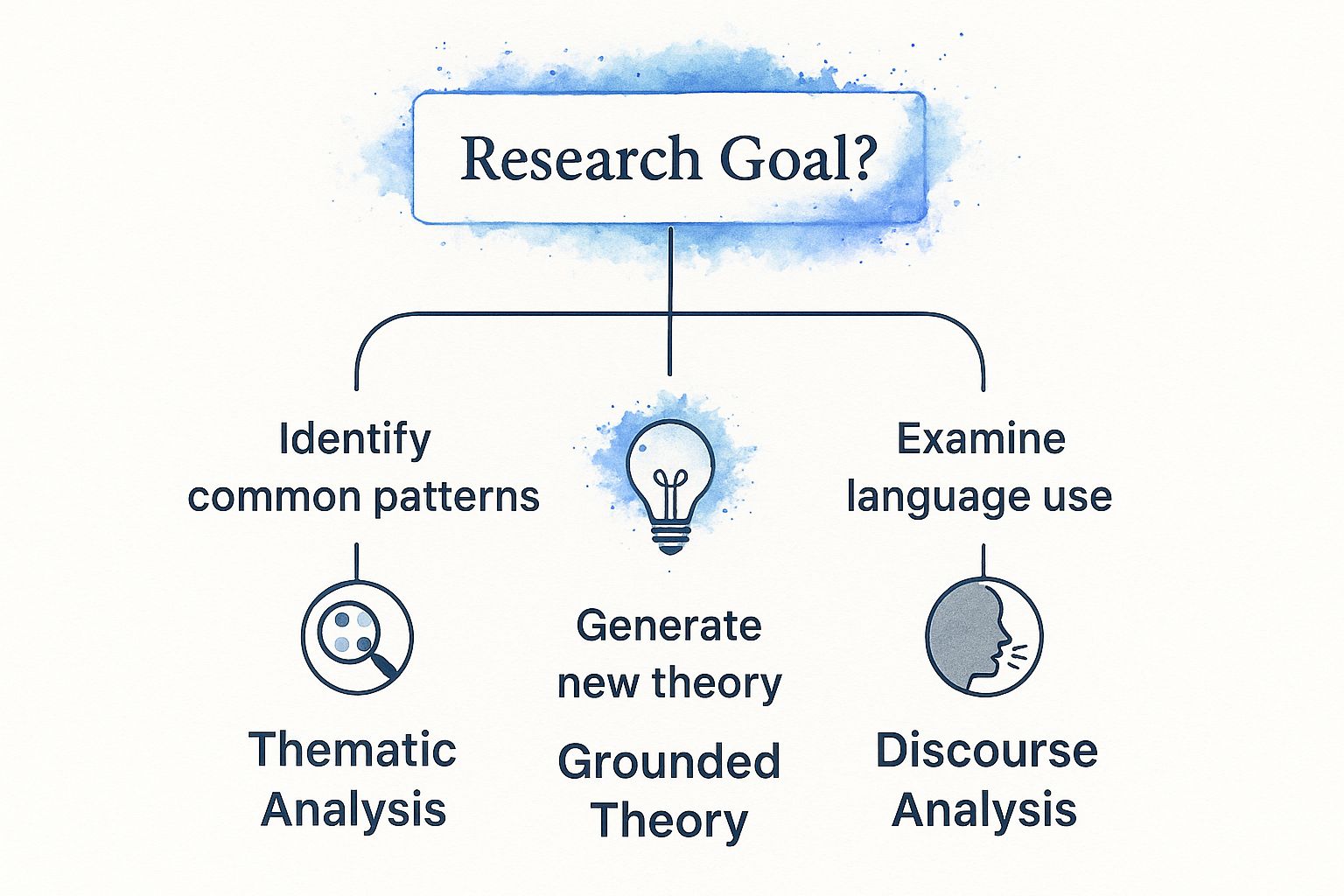
As you can see, the central goal of your research is the most important piece of the puzzle. It’s what guides you forward.
Accurate results regardless of accent or language — just upload and go Start transcribing
Consider the Nature of Your Data
Next up, take a good, hard look at the data you've collected. The format, depth, and texture of your data will make certain methods feel like a perfect match while making others almost impossible to use. You can’t exactly do a Narrative Analysis without actual narratives, right?
Ask yourself what your data actually looks like:
- Do you have long, detailed interviews or personal life stories? This kind of rich, personal data is the ideal raw material for Narrative Analysis, where the structure of the story is just as important as the content.
- Is your data a mix of different sources, like documents, social media posts, and open-ended survey answers? This is where Content Analysis shines. It lets you systematically categorize and count specific words or concepts across a wide variety of materials.
- Are your interview transcripts packed with detail? High-quality, word-for-word transcripts are the lifeblood of nearly every qualitative method. Using a reliable tool like Typist ensures you capture every little nuance, which is absolutely critical for methods like Thematic or Discourse Analysis.
Start transcribing with Typist →
Aligning Method with Outcome
Finally, think about the end game. What do you want your final report or presentation to achieve?
If you want to present a clear, easy-to-digest summary of the top issues people brought up, Thematic Analysis is perfect. It gives you clean, well-defined themes that are simple to communicate. But if your goal is to challenge an existing idea and propose a whole new way of thinking, Grounded Theory provides the rigorous framework to build that new model from scratch.
To help put it all together, here’s a quick-glance table comparing some of the most common methods.
Choosing Your Qualitative Analysis Method
This table breaks down which method might be the best fit based on what you’re trying to accomplish, the data you're working with, and the kinds of questions you’re asking.
| Method | Primary Goal | Best For Analyzing... | Example Research Question |
|---|---|---|---|
| Thematic Analysis | Identify shared patterns and experiences | Interview transcripts, focus group discussions | "What are the common challenges faced by new entrepreneurs?" |
| Content Analysis | Quantify the frequency of specific concepts | Customer reviews, news articles, survey responses | "How often is 'user-friendly' mentioned in our product feedback?" |
| Narrative Analysis | Understand how people construct stories | Life histories, in-depth personal accounts | "How do cancer survivors narrate their treatment journey?" |
| Grounded Theory | Generate a new theory from the data | Interviews and observations in unexplored areas | "How do gig economy workers develop a professional identity?" |
Ultimately, choosing your method is a strategic decision that will shape your entire research journey. By thinking carefully about your question, your data, and what you want to achieve, you can pick the perfect approach to unlock the powerful stories hidden in your data.
Still typing out transcripts by hand? Upload a file
Putting Thematic Analysis into Practice

Theory is great, but the real magic happens when you get your hands dirty. Let's make this tangible. Thematic Analysis is often the first method researchers learn, and for good reason—it’s flexible, powerful, and feels pretty intuitive once you get the hang of it.
So, let's walk through the process with a real-world example. Imagine you’re trying to understand the challenges faced by first-time remote workers. You've done your interviews and now you're sitting on a pile of transcripts. How do you get from pages of raw conversation to a handful of powerful, insightful themes? It all breaks down into six phases.
Phase 1: Getting to Know Your Data
Before you can even think about analyzing, you have to immerse yourself in the data. This isn't a quick skim. It’s an active, deep-dive reading process where you really listen to what's being said.
Read every transcript, maybe two or three times. As you go, scribble notes in the margins about interesting ideas or gut feelings. The goal here is to get a holistic sense of the conversations before you start slicing them up. What topics keep coming up? Which quotes really jump off the page? This step ensures your analysis is truly grounded in the data, not just a few memorable soundbites.
Phase 2: Generating Initial Codes
Alright, now the fun begins. It's time for coding. Think of a code as a short label or tag you stick on a piece of text to capture its core idea. You'll go through your transcripts, line-by-line, and "tag" any segment that feels relevant to your research question.
For our remote worker study, you might create codes like:
- “Feeling isolated” for a quote about missing the casual office banter.
- “Home distractions” when someone tells a story about their cat walking across the keyboard during a meeting.
- “Can’t switch off” for a comment about checking work emails late into the evening.
At this stage, be thorough. The goal is to capture everything that might be important, breaking down the data into its smallest meaningful chunks. Don't worry about organizing just yet—that comes next.
Phase 3: Searching for Themes
Now you have a long list of codes. It's time to zoom out and look for the bigger picture. In this phase, you start sorting and grouping similar codes together to form potential themes. A theme is a broader pattern of meaning that says something significant about your data.
You might notice that codes like “Feeling isolated,” “Missing colleagues,” and “No spontaneous chats” all seem to be pointing at the same core issue. You could bundle these under a potential theme called “Social Disconnection.” Likewise, codes like “Can’t switch off” and “Working longer hours” could point to a theme like “Blurring Work-Life Boundaries.”
A theme is more than just a summary of your codes. It’s the story the codes tell when you bring them together, revealing a significant pattern in your participants' experiences.
Start transcribing with Typist →
Phase 4: Reviewing Your Themes
That list of themes you just made? Think of it as a first draft. Now you have to pressure-test them against your data to see if they hold up. This happens on two levels:
- At the code level: Look at all the quotes you've assigned to a single theme. Do they really belong together? If a few feel out of place, you might need to move them to another theme or maybe even create a new one.
- At the dataset level: Read through your entire dataset again, but this time with your draft themes in mind. Do they accurately tell the overall story? Is there a big idea in the data that you've completely missed?
This is a crucial refinement step. You might end up merging two themes that are too similar, splitting a theme that’s too broad, or even ditching a theme that just doesn't have enough solid data to back it up.
Phase 5: Defining and Naming Your Themes
Once you're confident you have a solid thematic map, it's time to give each theme a proper name and definition. A good theme name should be punchy and immediately tell the reader what it's about (e.g., “The Struggle for Self-Discipline”).
For each theme, write a short paragraph that clearly explains what it means. What’s the story this theme is telling? How does it help answer your main research question? These definitions are the backbone of your final report.
Phase 6: Writing it All Up
The final phase is storytelling. Your report shouldn't be a dry list of themes. It needs to weave your analysis into a compelling narrative that guides your reader through what you discovered.
For each theme, present your definition and then bring it to life with vivid, illustrative quotes from your transcripts. This is how you show, not just tell. It provides the evidence for your interpretations and makes your report feel deeply human and relatable.
Got Questions? Let's Unpack Some Common Ones
Even after you've picked a method, stepping into the world of qualitative analysis can feel a bit like learning to navigate by the stars. It's totally normal to have questions. This last section is all about tackling those common head-scratchers so you can move forward with confidence.
How Do I Know My Findings Are Actually Legit?
In the world of numbers and stats, people talk about "validity." In qualitative research, we chase something a little different: trustworthiness.
Trustworthiness isn't about proving you're "right." It’s about showing that your findings are credible, dependable, and deeply rooted in the experiences of the people you talked to. It's about building a solid, transparent case for your interpretations.
Here are a few tried-and-true ways to build that trust:
- Triangulation: Think of this as getting a second (or third) opinion. You use multiple sources of data to see if they point to the same conclusion. For instance, if a comment from an interview is echoed by something you witnessed during an observation, your finding is suddenly a lot more solid.
- Member Checking: This one is powerful. You take your early findings back to the people you interviewed and ask, "Does this sound right? Does it capture what you told me?" This gives them a voice in the process and ensures you're representing their story faithfully.
- Peer Debriefing: It's so easy to get lost in your own data. Grab a colleague who isn't attached to the project and walk them through your analysis. A fresh set of eyes can challenge your assumptions and spot things you might have missed.
- A Detailed Audit Trail: Basically, you document everything. Keep meticulous records of your raw data, your coding decisions (and why you made them), and how your themes took shape over time. This transparency lets anyone follow your thought process from start to finish.
Using these techniques shows that your conclusions aren't just pulled out of thin air—they're the result of a rigorous and defensible process.
Should I Bother Using Qualitative Analysis Software?
You could do your analysis with a pile of printed transcripts, a pack of highlighters, and a pair of scissors. People have certainly done it. But for any project involving more than a handful of interviews, using specialized software is a game-changer.
Think of tools like NVivo, MAXQDA, or Dedoose as your digital command center. They don't do the critical thinking for you, but they are fantastic at managing the chaos.
This software helps you:
- Keep all your files—transcripts, notes, images, PDFs—organized in one spot.
- Easily "tag" or code segments of text without cutting and pasting for hours.
- Instantly pull up every piece of data related to a specific code.
- Create visuals to help you see how different ideas connect.
The real brain work—the interpretation, the insight, the "aha!" moments—is still all on you. But the software handles the tedious administrative tasks, freeing up your mental bandwidth to focus on what truly matters: discovering what the data is trying to tell you.
What’s the Real Difference Between a Code and a Theme?
This is probably one of the most fundamental questions in qualitative research analysis methods, and getting it clear in your head makes everything else fall into place.
Let's use an analogy. Imagine you just dumped a giant box of LEGOs on the floor.
A code is like a single LEGO brick. It’s the smallest individual unit of meaning. You might label one brick "small red square" and another "long blue rectangle." In your data, a code is a short label you attach to a specific idea—like tagging a sentence where someone feels disconnected with the code "loneliness."
A theme is what you build with those bricks. You might gather up all the red pieces to build a fire truck. The theme isn't just "a pile of red bricks"; it’s the "fire truck"—the bigger, more meaningful pattern that emerges when you put the individual pieces together.
So, in your research, you might notice that codes like "loneliness," "missing colleagues," and "no office chat" keep popping up together. When you group them, you create a broader theme: "Workplace Social Isolation."
Simply put, codes are your building blocks. Themes are the meaningful structures you build with them.
Three free transcriptions. No credit card.
See how fast and accurate Typist is — upload your first file in seconds
How Many People Do I Actually Need to Interview?
Ah, the million-dollar question. The answer can feel a bit frustrating: "It depends." Unlike quantitative studies that need large numbers for statistical significance, qualitative research is all about reaching data saturation.
Saturation is the point you reach when new interviews stop giving you new insights. You start hearing the same stories, the same opinions, the same themes, just in slightly different words. You’ve essentially heard it all.
There’s no magic number for this:
- For a very focused, niche study, you might hit saturation after just 6-10 deep conversations.
- For a more complex topic with a diverse group of people, you might need 20-30 interviews or even more.
The goal isn't quantity; it's the richness and depth of the information. You keep going until you feel confident that you have a full, nuanced understanding of what you're studying. Once you hit that point, you have enough.