Finding the Best AI Transcription Service for Your Needs
Searching for the best AI transcription service? We compare the key features, accuracy, and speed to help you choose the right tool for any project.
Finding the right AI transcription service isn't about picking the one with the flashiest marketing. It's about finding a tool that actually fits what you do every day. While we're big fans of Typist for its fantastic mix of speed, accuracy, and user-friendly design, knowing what to look for is the first step toward making a smart decision.
What Makes a Great AI Transcription Service
The need for fast, reliable transcription is exploding. The global market, currently valued at around $4.5 billion, is expected to skyrocket to over $19 billion by 2034. This isn't just a trend; it's a fundamental shift in how professionals in media, business, and education are handling audio and video content.
When you're sifting through the options, it’s easy to get lost in feature lists. The trick is to focus on the core things that will genuinely impact your work and the quality of the final transcript.
The Make-Or-Break Metrics
Before you even look at bells and whistles, make sure any service you're considering nails these fundamentals. These are the pillars of a tool that won't let you down.
- Transcription Accuracy: This is everything. A top-notch service delivers clean text, even when dealing with tricky audio—think background noise, overlapping speakers, or a variety of accents.
- Turnaround Time: In today's world, speed matters. The best services, like Typist, can transcribe an hour of audio in just a handful of minutes. That’s the difference between getting a project done today versus tomorrow.
- Speaker Identification: If you're transcribing interviews, meetings, or podcasts, you need a tool that can automatically tell who is speaking. This feature, known as diarization, can save you hours of tedious manual labeling.
- Language Support: Your work isn't always in one language. A truly useful tool should handle a wide range of languages and dialects, making it a valuable asset for global teams or diverse content.
Never miss a word from lectures or interviews
Record once, transcribe instantly. Search, export, and reference later
Features That Power a Modern Workflow
Once the basics are covered, a few key features separate a decent service from an indispensable one. These are the details that create a smooth, efficient process from start to finish. Security, for instance, should never be an afterthought. It's vital to understand how your data is protected, which is why we recommend reviewing Typist's commitment to user privacy.
To help you cut through the noise, we've put together a quick guide on what really defines a top-tier transcription service.
Key Features of a Top-Tier AI Transcription Service
| Feature | Why It Matters | What to Look For |
|---|---|---|
| High Accuracy | A more accurate transcript means less time spent editing and correcting mistakes. It ensures the final text is reliable. | Look for consistent performance with challenging audio, like files with heavy accents, technical jargon, or background noise. |
| Fast Turnaround | Get your projects moving faster. Quick transcription allows for rapid content creation, analysis, and distribution. | The best services measure processing time in minutes, not hours. An hour of audio should be done in under 10 minutes. |
| Speaker Diarization | Makes transcripts of multi-person conversations (meetings, interviews) scannable and easy to understand at a glance. | The service should automatically and clearly label each speaker turn (e.g., "Speaker 1," "Speaker 2"). |
| Multiple Export Formats | You need your transcript to work with other tools. Compatibility is key for a smooth workflow. | Check for common formats like DOCX for documents, SRT for video subtitles, and TXT for plain text. |
| Secure Platform | Your audio and video files can contain sensitive or confidential information. It needs to be protected. | Look for clear privacy policies and strong data security measures, like encryption. |
Ultimately, you're looking for a tool that just works—one that slides into your existing process without causing friction. A clean interface, dependable performance, and a smart set of features are the signs of a service that’s truly built for professionals.
Try Typist free - Get 3 transcripts daily
How We Tested These Transcription Tools
To pick the best AI transcription service, you need to look past the marketing hype. So, we developed a straightforward, hands-on testing process to see how these tools perform in the real world. This isn't about just listing features; it's about measuring what actually matters.
Our entire review process rests on four key pillars. Each one represents a critical part of what makes a transcription tool genuinely useful, from the quality of the text it spits out to how easy it is to work with day-to-day.
The Four Pillars of Our Evaluation
We zeroed in on the things that directly affect your work and the quality of the final transcript.
- Accuracy Benchmarks: This is the big one. We threw a variety of challenging audio files at each service—recordings with multiple speakers, thick accents, background noise, and even niche-specific jargon. The goal was to see how the AI held up when the audio wasn't perfect.
- Speed and Efficiency: How long does it take to get your transcript back? This is a huge deal for productivity. We timed everything from the moment we hit 'upload' on a one-hour audio file to the second the finished transcript landed in our hands.
- User Experience (UX): A powerful tool is worthless if it's a pain to use. We evaluated the entire process: how simple it is to upload files, how intuitive the editor feels for making corrections, and how easy it is to export the text in different formats.
- Core Feature Set: Beyond just getting the words right, we looked at the professional features that save time. This meant testing speaker identification (diarization), checking the accuracy of timestamps, seeing if we could add custom vocabulary, and exploring what integrations were available.
No complex setup, no learning curve. Drag, drop, transcribe Try it free
Why a Structured Approach Matters
Without a consistent method, it's easy to be impressed by one flashy feature and miss a tool's fundamental flaws. A structured approach forces an honest, all-around look. For example, a service might boast 99% accuracy, but our tests often show that number plummets with real-world challenges like people talking over each other or a noisy cafe environment.
By testing every tool against these four pillars, we can see which ones consistently deliver. This process is why we can confidently say Typist comes out on top—it’s a recommendation backed by a complete, balanced evaluation.
When you're choosing your own tools, it helps to follow general principles for selecting the best AI tools to make sure you're covering all your bases. Our focus on speed, for example, isn't just about impatience. It's about how that turnaround time affects your entire workflow. We actually put a lot of engineering effort into this, which you can read about in our post on how we built one of the fastest AI audio transcription services. This methodical process ensures our final recommendation is one you can trust.
Try Typist free - Get 3 transcripts daily
A Detailed Analysis of AI Transcription Services
https://www.youtube.com/embed/pJQpSacq67k
When you start comparing AI transcription services, you quickly realize the devil is in the details. It’s not just about turning speech into words. The real question is: does the final transcript save you time, or does it create hours of cleanup work? My analysis cuts through the marketing noise to focus on what actually impacts your workflow.
If you ask me what really matters in a transcription tool, it boils down to three things: accuracy, speed, and how easy it is to use. This graphic lays it out perfectly.
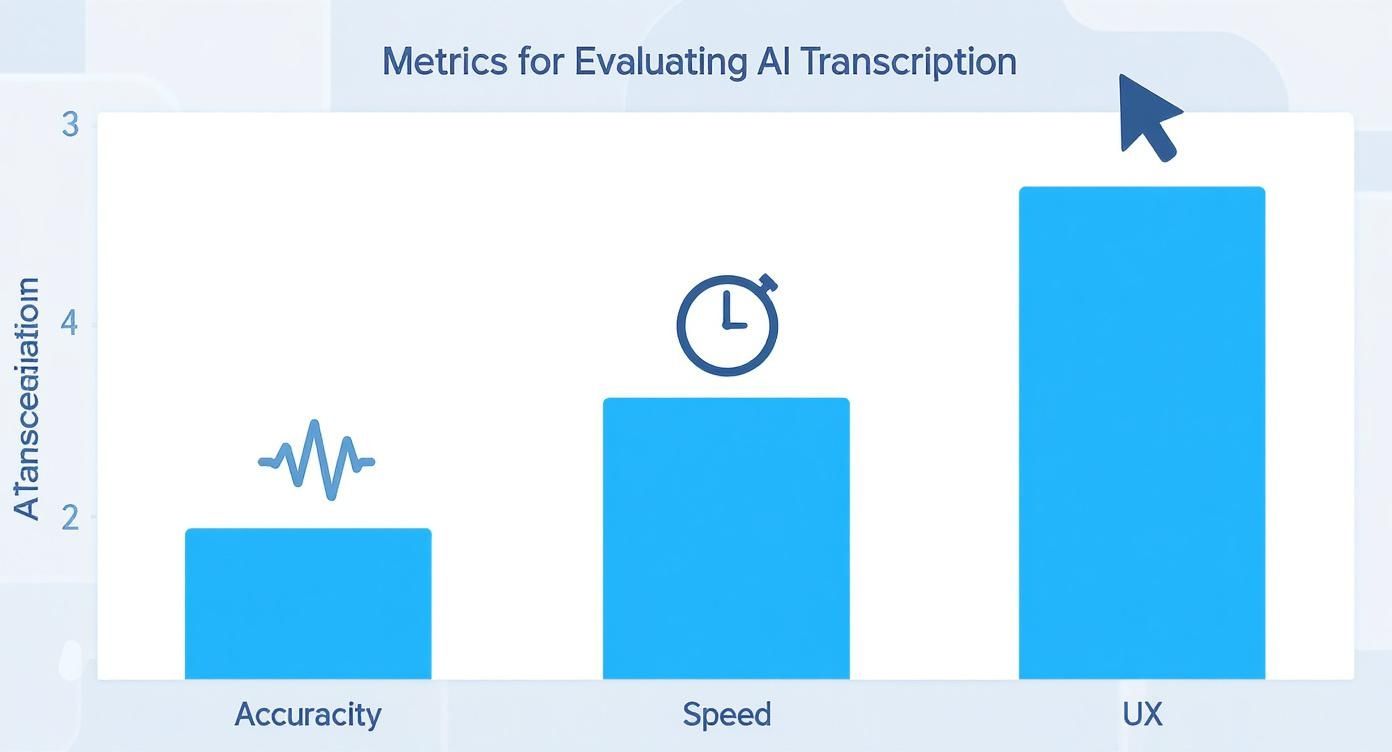
As you can see, speed is great, but it’s almost worthless if the transcript is riddled with errors or the software is a pain to navigate. The best tools, like Typist, find that sweet spot where all three work together seamlessly.
Accuracy Under Pressure
The real test for any transcription AI isn't a perfectly clear, studio-recorded monologue. It’s the messy audio we all deal with every day—a conference call with people talking over each other, an interview in a loud coffee shop, or a technical webinar loaded with jargon. This is where most services fall apart.
Typist was built for these exact scenarios. Its AI has been trained on a massive variety of real-world audio, which means it’s much better at separating speakers, understanding different accents, and getting specialized terms right.
Many tools boast high accuracy rates, but watch what happens when you throw some background noise or a few extra speakers into the mix. A great service holds up, saving you the headache of a massive editing job.
Think about transcribing a focus group for market research. You’ve got a lively, overlapping conversation. A lesser tool will give you a jumbled mess of text. Typist, on the other hand, uses its smart speaker identification to produce a clean, organized script where you can see exactly who said what. It makes the actual analysis so much faster.
The Real Value of Speed
Speed in transcription isn't just a nice-to-have; it's a game-changer for productivity. Getting a transcript back fast means you can act on it right away. For a journalist, that could mean beating a competitor to print. For a YouTuber, it's getting subtitles up in minutes instead of hours.
Typist processes an hour-long file in just a few minutes, which completely changes how you work. There’s no more waiting around. You can start editing, sharing, and repurposing your content almost instantly. That kind of speed lets you focus on what really matters, not on the grunt work.
A Clear Look at Pricing and Value
Let's be honest: the pricing for many AI transcription tools is a confusing mess of credits, per-minute fees, and tiered plans that hide the best features. It makes it nearly impossible to predict your costs. And with the U.S. transcription market valued at USD 30.42 billion and growing, the demand for straightforward pricing is huge. You can read more about the transcription market's growth to see why clear value is so critical.
Typist avoids all that complexity with a simple, honest approach. The free plan gives you 3 full transcripts every single day—not a limited trial, but a genuinely useful tool for anyone with regular transcription needs. You get to see how powerful it is without spending a dime.
For heavy users, the premium plan offers unlimited transcriptions for one flat price. No more counting minutes or worrying about surprise bills. It’s predictable and provides incredible value. We often share more about our product philosophy and updates, which you can find by exploring our articles on the Typist blog.
To see how this stacks up, let’s put the features head-to-head.
AI Transcription Feature Showdown
This table cuts right to the chase, showing how Typist’s features compare to what you’ll typically find elsewhere. It’s these practical differences that make all the difference in your day-to-day work.
| Feature | Typist's Approach | Typical Industry Standard |
|---|---|---|
| Free Tier Offering | Provides 3 full transcripts daily, making it consistently useful for ongoing projects without any cost. | Often just a small, one-time trial with a few minutes of credit that expires quickly, forcing you into a paid plan. |
| Accuracy with Noise | Uses sophisticated noise-filtering to keep accuracy high, even when the audio is recorded in a busy place. | Accuracy plummets in noisy settings, leaving you with a transcript that needs heavy manual correction. |
| Speaker Identification | Clearly and accurately separates speakers, even when they’re talking over each other in a fast conversation. | Struggles to tell voices apart, often mixing up or merging speakers, which creates a huge editing nightmare. |
| Pricing Model | Simple and transparent. A truly useful free plan and a single, affordable unlimited plan with no hidden fees. | Complicated per-minute billing, confusing credit systems, and tiered plans designed to push you to more expensive options. |
When you lay it all out, it's clear that Typist isn't just another transcription tool. It's been designed from the ground up to be more practical, powerful, and user-friendly.
How AI Transcription Fits Into Your Daily Work
Upload MP4 or MOV, export SRT subtitles. Works with Premiere, Final Cut, DaVinci Try it free
It's one thing to talk about features, but it's another to see how a tool actually solves problems. A clean interface, like the one you'll find in Typist (https://iamtypist.dev), is built to make professional workflows feel second nature. It gets you from a raw audio file to a polished document without any fuss.
The real magic of AI transcription is how it plugs into the day-to-day grind for people in all sorts of fields. This isn't just a neat piece of tech; it’s an essential part of modern work, which is why the U.S. transcription market is expected to rocket past USD 50 billion by 2035. Let's look at a few examples of where it makes a real difference.
Podcasters and Content Creators
If you're a creator, you know the clock is your biggest enemy. Turning a great conversation into written content can feel like a massive chore, but AI transcription flips that on its head. It basically becomes a content multiplier.
Think about it: a single one-hour podcast episode can be spun into several different assets in just a few minutes.
- Show Notes: The full transcript is your foundation for creating detailed notes, complete with timestamps that let listeners jump straight to the good parts.
- Blog Posts: You can pull the main ideas from the episode and quickly shape them into an article, opening up your content to a whole new audience through search engines.
- Social Media Snippets: Finding those killer quotes or insightful moments becomes a breeze. Just copy, paste, and you’ve got a week's worth of engaging posts for Twitter or LinkedIn.
This is the core of smart content repurposing strategies. With a tool as fast as Typist, you can have a transcript ready for editing almost as soon as you hit "stop" on your recording.
Researchers and Students
Academic life is a firehose of information. You're constantly absorbing interviews, lectures, and seminars, and trying to transcribe it all by hand is a recipe for burnout.
A good AI transcription service completely changes the game. A student can upload a two-hour lecture and get a searchable text file back in minutes, making it ridiculously easy to find specific concepts while studying. For a researcher doing qualitative analysis, the accuracy of speaker labels in a tool like Typist is a lifesaver. It neatly separates the interviewer from the interviewee, which makes coding and analyzing the data so much faster.
Business Professionals
In the business world, you can't afford misunderstandings. Clear records are everything, and AI transcription offers a bulletproof way to document what was said.
A detailed, searchable transcript of a client call or project meeting serves as a single source of truth. It eliminates ambiguity over action items, decisions, and deadlines, ensuring everyone on the team is aligned.
This is especially helpful for remote teams scattered across different time zones. Instead of forcing someone to sit through a long meeting recording, they can just scan the transcript for the parts that matter to them. It’s a massive time-saver.
Journalists on a Deadline
For journalists, every second counts. When a story is breaking, the time it takes to get quotes from an interview into your article can mean the difference between getting the scoop and being late to the party.
With a tool like Typist, a reporter can upload an audio file from their phone right in the field and have a transcript back almost instantly. This means they can start writing immediately, pulling accurate quotes without having to listen back to the audio over and over. The precise timestamps are also clutch for quickly finding a specific moment to double-check context.
Getting Started with AI Transcription Today
Transcribe a 1-hour recording in under 30 seconds
Upload any audio or video file and get a full transcript with timestamps
Jumping into AI transcription shouldn't be a chore. With the right tool, you can turn a hefty audio file into a clean, ready-to-use document in just a few minutes. The whole point is to get the tech out of your way so you can focus on the work that actually matters.
Here’s how you can get started with Typist and see the difference for yourself.
We designed the dashboard to be clean and simple. Your files are just a drag-and-drop away from becoming accurate text.
Your First Transcript in Four Simple Steps
Getting a top-tier AI transcription service folded into your daily routine is surprisingly easy. Typist is built for speed and efficiency, cutting out the fluff so you can get right to your content.
- Sign Up for Free: First, create your account. This instantly gives you three free transcripts for the day—no credit card needed to get your feet wet.
- Upload Your File: Next, just drag and drop your audio or video file (like an MP3, MP4, or WAV) right onto the dashboard. The transcription kicks off immediately.
- Review and Refine: Once it's done, the transcript pops up in the online editor. You can play the audio, which stays synced with the text, making it a breeze to tweak any words or phrases.
- Export Your Document: Finally, download your finished transcript in the format you need. We've got you covered, whether it's a DOCX for reports, an SRT for video captions, or a simple TXT file.
This straightforward workflow is exactly why so many professionals have come to rely on Typist. If you have any specific questions or need to discuss enterprise-level features, feel free to get in touch through the Typist contact page.
A great transcription tool should feel invisible. It should slide into your workflow so seamlessly that you forget about the technical steps and just focus on the value you're pulling from your spoken content.
There’s no reason to put it off. You can test out the speed and accuracy for yourself today and see what a difference it makes for your productivity.
Need subtitles? Show notes? Meeting minutes? Try it free
Frequently Asked Questions About AI Transcription
Choosing the right AI transcription tool can feel overwhelming. Let's break down some of the most common questions people ask to help you figure out what really matters.
How Accurate Is AI Compared to a Human Transcriber?
This is the big one, isn't it? On paper, the best AI services boast accuracy rates between 85% and 98% in perfect conditions. But real-world audio is rarely perfect. The true test is how an AI handles background noise, heavy accents, or people talking over each other.
A human transcriber will almost always win on nuance and context, hitting that 99% accuracy mark. However, the gap is closing fast. Top-tier tools like Typist are trained on messy, real-world audio, which means they deliver surprisingly accurate transcripts even when the sound quality is far from ideal. The goal is to find a service that doesn't crumble when things get complicated.
Start transcribing with Typist →
Can an AI Tell Different Speakers Apart?
Absolutely, and for anyone transcribing meetings, interviews, or podcasts, this feature is a lifesaver. It’s officially called speaker diarization, but you can just think of it as speaker identification. Instead of giving you a giant, unreadable block of text, the AI automatically figures out who is talking and labels the dialogue (e.g., "Speaker 1," "Speaker 2").
This simple feature makes a transcript so much easier to read and analyze. Typist is particularly good at this, cleanly separating voices even when the conversation gets lively. It saves you the headache of going back through and manually figuring out who said what.
Is My Data Safe with an AI Transcription Service?
It's a smart question to ask, especially when your recordings might contain sensitive information. Any AI transcription service worth its salt takes security seriously. This means having strong protections in place to keep your files from falling into the wrong hands.
Always check for a clear and straightforward privacy policy that explains how your data is stored and managed. The best platforms use encryption to protect your files while they're being uploaded and while they're stored on servers. You need to trust the service you're using, so don't settle for anything less than a clear commitment to your privacy.