Focus Group Transcription Services: Accurate, Quick & Easy
Discover how focus group transcription services turn conversations into actionable insights. Learn how to choose the right partner and get accurate transcripts.
Think of focus group transcription services as the key that unlocks the treasure chest of insights you just gathered. All those lively discussions, unfiltered opinions, and "aha!" moments are captured in your audio files. A transcription service turns that raw conversation into a clean, readable text document you can actually work with.
This isn't just about getting words on a page. It's the essential first step in transforming spoken feedback into real, actionable intelligence for your business.
Unlocking Insights from Your Focus Group Audio
Imagine trying to analyze your focus group audio by just listening back and jotting down notes. It’s nearly impossible. You’re bound to miss crucial details, misremember who said what, or lose the exact phrasing of a brilliant piece of feedback.
A transcript is your ground truth. It lays everything out, word for word, letting you move past messy notes and into a structured, systematic review of the entire conversation.
From Chaotic Conversation to Structured Data
A raw audio file is a jumble of voices, ideas, and interruptions. It’s pure chaos. A transcript brings order to that chaos, turning it into a structured dataset that makes real analysis possible.
Here’s why that shift is so important:
- Captures Every Detail: Good transcripts get it all—every word, every pause, even when people talk over each other. These subtle cues are often where the most honest sentiments are hiding.
- Enables Deep Analysis: Once you have text, you can use simple tools like search to find keywords, spot recurring themes, and tag different sections. This is the foundation of true qualitative analysis.
- Facilitates Collaboration: Sending your team a transcript to review is way more efficient than asking them to listen to hours of audio. Everyone can jump in, highlight powerful quotes, and work together on the findings.
This process is what turns a free-flowing discussion into a goldmine of organized information. While this applies to groups, the same principles are vital for one-on-one sessions. You can learn more from this comprehensive guide on how to conduct user interviews to sharpen your skills there.
Building Credible and Defensible Research
When it comes time to present your findings, a detailed transcript is your best friend. It provides the hard evidence you need to back up your conclusions. You can pull direct, impactful quotes from participants to illustrate your points and build a much stronger case.
Using precise quotes from a transcript adds a layer of authenticity and credibility to your research findings that summarized notes simply cannot match. It connects your conclusions directly to the voice of the customer.
Ultimately, using focus group transcription services goes far beyond simple convenience. It’s a matter of research integrity. It ensures you’re working with the most accurate data possible, helping you turn valuable conversations into the kind of clear insights that lead to smarter business decisions.
Why Transcript Accuracy Is a Deal-Breaker in Research
In qualitative research, your insights are only as good as the data you're working with. Think of your focus group transcript as the raw material for your entire analysis. If that material is warped or full of holes, everything you build with it will be shaky. A single word taken down wrong or a quote assigned to the wrong person can completely derail your understanding and send your research down a dead end.
This isn't just about picky details; it's about the very integrity of your work. When transcripts are off, you get flawed insights. Those flawed insights can lead to disastrous marketing campaigns, poorly designed products, and a ton of wasted money. You run a focus group to hear what people really think, and that voice gets muffled and distorted with every mistake in the transcript.
Upload a file. Get text back. That simple.
No complex setup, no learning curve. Drag, drop, transcribe
The Unique Chaos of Focus Group Audio
Let’s be honest: focus group recordings are a mess. They are nothing like a clean, controlled one-on-one interview. The lively, dynamic nature of these conversations is great for gathering rich data, but it presents a real headache for transcription.
- Multiple Overlapping Speakers: People get excited. They talk over one another, finish each other's sentences, and chime in all at once. Untangling who said what is a huge challenge.
- Cross-Talk and Interruptions: A natural conversation is full of quick asides, interruptions, and little side-chats. It's how humans communicate, but it can easily stump basic transcription software.
- Industry-Specific Jargon: Every field has its own shorthand and terminology. If the transcription service doesn't understand your industry's language, you'll end up with bizarre and meaningless phrases.
- Varying Accents and Pacing: A room full of different people means a mix of regional accents, speaking speeds, and volumes, all of which add another layer of complexity.
These are the exact reasons why you can't afford to compromise on accuracy. For a long time, the only answer was painstaking manual transcription. But now, specialized AI tools like Typist are built to navigate this kind of audio chaos, offering a much faster and still highly reliable option. You can read more about how this technology works on the Typist blog.
To see this in action, let's look at how accuracy directly influences the quality of your research findings.
Impact of Transcription Accuracy on Research Outcomes
| Research Stage | Low-Accuracy Transcript Outcome | High-Accuracy Transcript Outcome |
|---|---|---|
| Data Coding | Themes are misidentified or missed entirely. Codes are applied incorrectly. | Themes emerge clearly and accurately. Codes reliably reflect participant meaning. |
| Sentiment Analysis | Sarcasm, nuance, and true sentiment are lost, leading to skewed results. | Tone and sentiment are captured precisely, providing a true emotional landscape. |
| Quote Selection | Powerful quotes are unusable due to errors, or worse, misattributed. | Key quotes are clean, compelling, and correctly assigned, strengthening your report. |
| Final Reporting | Conclusions are based on flawed data, making them weak and indefensible. | Findings are robust, evidence-backed, and can be presented with confidence. |
As you can see, the difference is night and day. High accuracy isn't a "nice-to-have"; it's essential for producing work you can stand behind.
The High Cost of Getting It Wrong
The ripple effect from a bad transcript can be enormous. Just imagine your team spends months and a small fortune developing a new product feature based on what you thought was a key insight from a focus group—an insight that was actually just a transcription error. The entire effort would be built on a faulty foundation.
An inaccurate transcript isn't just a document with typos; it's a corrupted dataset. It undermines the validity of your entire research project and makes your findings difficult, if not impossible, to defend.
The need for dependable transcription is only getting bigger. In fact, the marketing transcription market research—which leans heavily on data from focus groups—is projected to hit USD 5.64 billion by 2035. This surge is all about getting clean, accurate text to feed into modern analysis tools.
Ultimately, putting accuracy first is about protecting your research from the ground up. It ensures that the story you tell is the one your participants actually told, letting you make decisions that are smart, strategic, and based on reality.
Start transcribing with Typist →
Choosing Between Human and AI Transcription
So, you have your focus group recording and you need a transcript. This brings you to a major crossroads: do you go with a traditional human transcription service or a modern AI platform? There’s no single right answer here. The best choice really boils down to what matters most for your specific project—speed, budget, or pinpoint accuracy.
AI transcription tools like Typist are unbelievably fast. Seriously. You can upload an hour-long audio file and get a full transcript back in just a few minutes. For any researcher on a tight deadline, that kind of speed is a game-changer.
On top of that, AI is incredibly budget-friendly. Automated services cost a fraction of what human transcribers charge, which means you can get more done without blowing through your research funds.
The Power of AI Transcription
The world of AI is moving at lightning speed, and transcription is no exception. This explosive growth is all thanks to the technology getting smarter and more reliable every day.
The secret sauce behind these platforms is a field of AI called Natural Language Processing (NLP). It’s what helps the machine understand speech, but even the most advanced systems have their limits. They can sometimes get tripped up by the beautiful chaos of a real human conversation—think people talking over each other, thick accents, or industry-specific jargon.
This is exactly where a human expert can still make all the difference.
Human Insight vs. The Hybrid Approach
A human transcriber has an intuitive grasp of context that machines just can't replicate yet. They can pick up on sarcasm, figure out who’s speaking in a noisy room, and understand the subtle nuances that give a conversation its true meaning. If your research depends on capturing every last detail perfectly, that human touch is priceless.
But, as you’d expect, this level of detail comes at a price. Human transcription takes more time and costs more money.
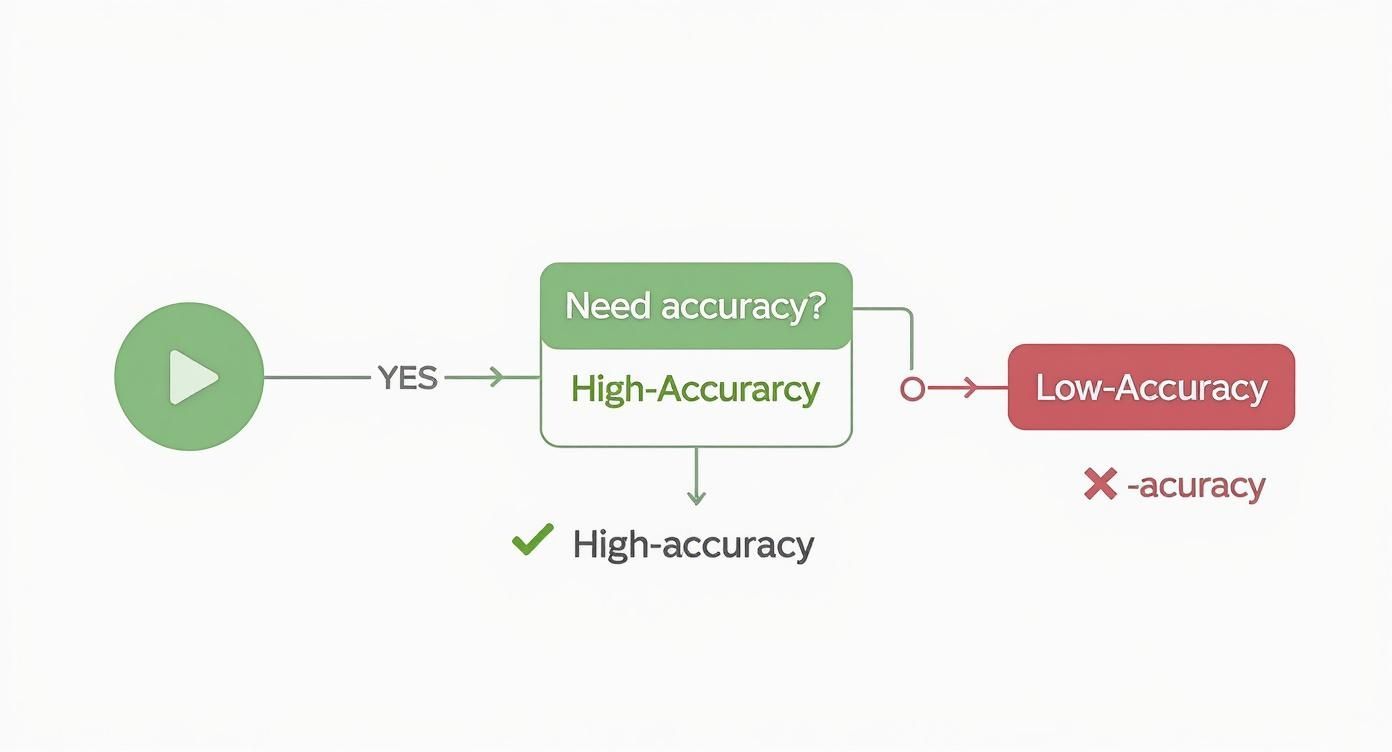
So, what's the solution? For many researchers, the answer is a hybrid model.
You start by running your audio through a speedy AI tool like Typist to get a solid first draft. This does about 90% of the heavy lifting for you in minutes. Then, you or a team member can do a quick pass to clean up any mistakes, assign the correct speaker labels, and polish the text. If you want to dive deeper into the tech, you can read our post on https://iamtypist.dev/blog/building-fastest-ai-audio-transcription.
This simple process gives you the best of both worlds: the speed and low cost of AI, combined with the precision of a final human review.
What to Look For in a Transcription Service
Generate subtitles for any video
Upload MP4 or MOV, export SRT subtitles. Works with Premiere, Final Cut, DaVinci
When you're picking a service for your focus group transcriptions, it's about so much more than just converting audio to text. The right platform has a few key features that can literally save you days of work and make your analysis sharper. It’s like the difference between a basic word processor and a full-blown data analysis suite—both let you type, but only one helps you find the meaning behind the words.
These aren't just fancy add-ons; they are absolute must-haves for any serious researcher. Without them, you'll spend more time fighting with your transcript than you will extracting the incredible insights locked inside it.
Automatic Speaker Identification
Let's be honest, figuring out "who said what" is the bane of every focus group analyst's existence. You have multiple people talking, sometimes at the same time, and manually labeling each speaker is a soul-crushing task. This is where speaker identification (sometimes called diarization) comes in to save the day.
A good transcription service can automatically tell the difference between voices in the audio, neatly labeling them "Speaker 1," "Speaker 2," and so on. All you have to do is go in once and assign the correct names. Just like that, a chaotic wall of text becomes an organized, easy-to-follow conversation, letting you see exactly what each person contributed.
Accurate and Navigable Timestamps
Ever found a killer quote in a transcript and wanted to hear how it was said? Without timestamps, you're stuck scrubbing through an hour-long audio file, trying to pinpoint that exact moment. It’s a huge waste of time.
That's why precise, word-level timestamps are non-negotiable. They act like a hyperlink, connecting every single word in the transcript back to its exact spot in the recording. With a single click, you can jump to the audio and hear the original tone, sarcasm, or hesitation for yourself. This simple feature is crucial for preserving the context and nuance of the conversation, which is where the real discoveries happen. To see how modern tools are built with this in mind, you can explore the technology behind a service like the one offered at https://iamtypist.dev/.
Flexible Export and Formatting Options
Your research process is your own, and your tools should bend to your will, not the other way around. A high-quality transcription service will let you export your work in a variety of formats that fit your workflow—like DOCX for writing reports, TXT for importing into other software, or SRT for adding captions to video clips.
Beyond file types, you should also have control over the style of the transcript itself.
- Verbatim: This is the transcript with everything left in—all the "ums," "uhs," stutters, and false starts. It’s perfect for detailed linguistic analysis where every little sound matters.
- Clean Read: This version edits out all the filler words and self-corrections, giving you a polished script that’s much easier to read. Most market researchers lean this way because it gets straight to the point.
Having these choices ensures the final transcript is ready for analysis the moment you download it, saving you from a mountain of tedious reformatting.
How to Prepare Your Audio for a Perfect Transcript
Transcribe a 1-hour recording in under 30 seconds Try it free
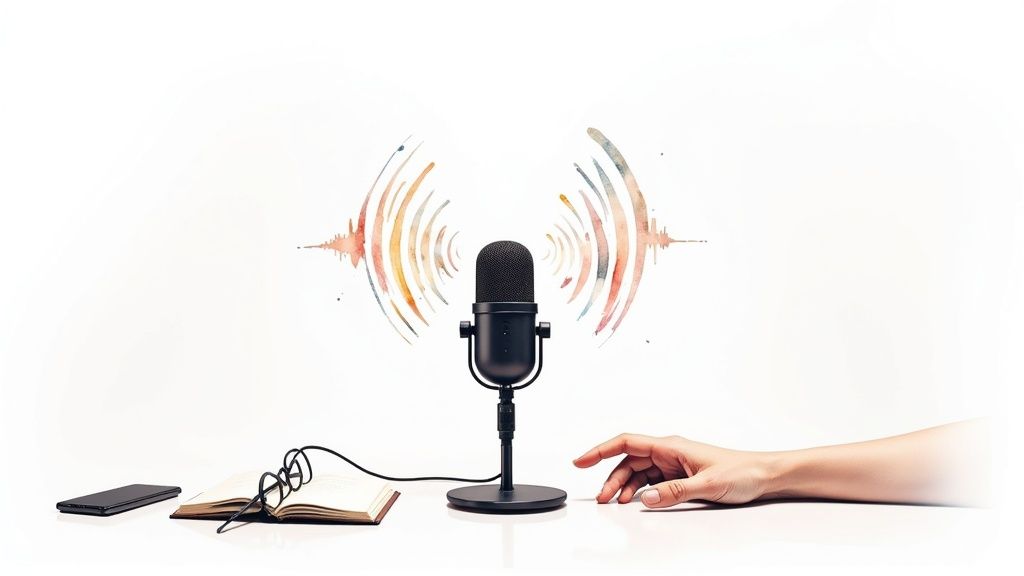
The secret to a great transcript isn't just about the service you pick—it starts with the quality of the audio you send them. Think of it like this: a great chef can't make a gourmet meal with subpar ingredients. A clean, crisp recording is the single most important thing you can do to get an accurate transcript, whether it’s handled by an AI or a human.
It all boils down to the old saying: garbage in, garbage out. If your recording is a mess of background noise, muffled voices, and people talking over each other, even the best focus group transcription services are going to have a hard time. A little prep work before you press record will save you a ton of headaches and editing time later on.
Master Your Recording Environment
You don't need a high-tech studio, but the room you choose makes a huge difference. Background noise is the ultimate villain when it comes to clear audio.
- Pick a Quiet Spot: Find a room that’s far from busy hallways, loud air conditioning units, or traffic noise. You'd be surprised how easily a simple refrigerator hum can get picked up and muddle the recording.
- Ditch the Echo: Rooms with bare walls and tile floors bounce sound all over the place, which creates an echo that can make voices hard to distinguish. If you can, opt for a carpeted room with curtains or soft furniture.
- Use an External Mic: Your laptop's built-in microphone is designed to grab sound from every direction, which means it also picks up keyboard taps and shuffling papers. A decent external USB or omnidirectional microphone placed in the middle of the table will do a much better job of capturing everyone's voice clearly.
Taking just a few minutes to set this up will dramatically improve the audio you have to work with.
Moderate for Clarity
As the moderator, you're not just guiding the conversation—you're also directing the audio quality. Your job is to encourage a dynamic discussion while preventing it from becoming an audio free-for-all.
A well-moderated focus group not only yields better insights but also produces cleaner audio. By gently guiding participants to speak one at a time, you directly improve the future accuracy of your transcript.
It's a good idea to remind participants to speak clearly and try not to talk over one another. A simple, friendly request at the beginning, like, "Let's try to let one person finish before the next person speaks," usually does the trick.
If you’re dealing with a particularly tricky session and need some advice, you can always get in touch with our team at Typist for some guidance. By managing the flow of conversation, you make sure every valuable comment is captured perfectly, giving you a transcript you can truly rely on.
Got Questions About Focus Group Transcription? We’ve Got Answers.
Diving into focus group transcription services for the first time? Or maybe you're just looking for a better way to handle your research workflow? Either way, you probably have a few questions. Getting straight answers is key to making smart decisions that keep your research on track.
Let’s walk through some of the most common questions researchers ask when turning spoken conversations into text. Once you get these fundamentals down, you’ll know exactly what to look for and how to get the most out of your qualitative data.
What’s the Difference Between Verbatim and Clean Read?
This is a big one. The style you pick really changes how the final transcript looks and feels.
A verbatim transcript is the raw, unfiltered version of the conversation. Think of it as a script that captures everything:
- Filler words like "um," "uh," and "you know"
- Stutters and sentences that trail off
- Even non-verbal sounds like laughter or a thoughtful pause
This super-detailed style is great if you’re doing deep psychological or linguistic analysis, where every little nuance counts. But for most market research, it’s honestly just noise that makes the transcript harder to read.
A clean read transcript (sometimes called intelligent verbatim) is what most people are looking for. It’s been lightly edited to be clear and readable. All the filler words are stripped out, and minor grammar mistakes are fixed, but the speaker's original meaning is perfectly preserved. It’s the go-to standard for business and research because the important messages pop right off the page.
For most projects, a clean read transcript hits the sweet spot. You get a professional, accurate document that’s ready for you to start coding and analyzing—saving you a ton of time without losing the essential insights.
Export your transcript to SRT, PDF, DOCX, or TXT — all from one upload Try it free
How Long Does It Take to Transcribe an Audio File?
Turnaround time is a huge deal, especially when you’re up against a deadline. How long it takes to transcribe one hour of audio can swing wildly depending on the method.
A traditional human transcriptionist usually needs about 24 to 48 hours to transcribe an hour of audio. That timeline can get even longer if the audio quality is bad, if there are strong accents, or if everyone is talking over each other.
This is where AI-powered focus group transcription services like Typist have a massive advantage. An automated platform can turn a one-hour focus group recording into a complete transcript in just a few minutes. That kind of speed means your research team can jump straight from collecting data to analyzing it.
How Do You Know Who Is Speaking?
In a focus group, keeping track of who said what is non-negotiable. The process of figuring this out and labeling each speaker is called speaker diarization.
Modern AI tools do this automatically. The software listens for unique vocal patterns in the audio and assigns a label like "Speaker 1" or "Speaker 2" to each person's dialogue. It’s incredibly fast. From there, you can easily go into the transcript and swap those generic labels with the actual participants' names for a clean, organized final document.
How Secure Are My Focus Group Recordings?
Data security should always be top of mind, especially when you're handling confidential research or personal information. Any transcription service worth its salt will have strong security measures in place.
Make sure any provider you consider uses SSL/TLS encryption when you upload and download files. This scrambles the data so it can't be intercepted. It’s also a good idea to read their privacy policy to see exactly how they store and manage your data. For a good example of what to look for, check out the Typist privacy policy. Choosing a service that’s upfront about its security practices gives you peace of mind that your research is in safe hands.
Ready to get fast, accurate transcripts for your next project? With Typist, you can turn hours of focus group audio into clean, analyzable text in minutes.